Cold Brew Coffee Caffeine Content
We often hear that a chilled steep yields a smoother, less acidic cup. That simple method means we steep grounds in cold or room-temperature water for 8–24 hours to extract flavor and strength.
On average, a 16-ounce serving contains around 200 mg of caffeine. Major brands illustrate variability: Starbucks lists about 205 mg per 16 oz and Dunkin’ shows roughly 260 mg per 16 oz.
Those numbers matter because the amount we drink affects energy, focus, jitters, and sleep. The smooth taste can mask how potent a drink is, so we need clear figures to plan our day.
This guide gives practical, U.S.-relevant steps. We will compare styles, explain how bean-to-water ratio, grind, and steep time control extraction, and show how concentrate or dilution changes the actual amount you consume.
Why we care about caffeine in cold brew right now
Understanding how much stimulation we get from a chilled steep matters now more than ever. Demand for cold brew has surged because many people prefer a smoother taste and steady energy.
The numbers matter to our day. At Starbucks a 16 oz cold brew lists about 205 mg versus an iced coffee at roughly 165 mg. Hot coffee can range from about 210 to 360 mg per 16 oz.
Steeping time typically runs 8–24 hours, and choices like dilution, ice melt, or milk change the actual intake per serving. That means two identical cups can deliver very different levels.
We care because stimulant intake affects work, anxiety, and sleep. Businesses and home brewers want predictable results to meet expectations and manage dosing.
- Track steep time and ratio to control strength.
- Read labels and measure serving size before you stack drinks.
- Plan your last cup to protect nighttime rest.
| Beverage | Typical mg per 16 oz | Main variables |
|---|---|---|
| Cold brew | ~200–260 mg | Steep time, ratio, dilution |
| Iced coffee | ~165 mg | Brew temp then chilled, dilution |
| Hot coffee | ~210–360 mg | Extraction heat, roast, serving |
Cold Brew Coffee Caffeine Content: the quick answer
For a fast answer, we focus on typical servings and the brand examples that shift the numbers.
Typical range per serving
A standard 16‑ounce serving contains around 200 mg on average. That figure gives a useful baseline for planning our day and tracking total intake.
Brand examples in the U.S.
Starbucks lists roughly 205 mg per 16 oz, while Dunkin’ reports about 260 mg for the same size. Those brand differences show how recipes and concentrate strength change the caffeine per cup.
Why results vary
Variability comes from bean-to-water ratio, grind size, steeping hours, water temperature, serving size, and dilution. Ice melt or extra water lowers the caffeine per serving even when the base concentrate stays strong.
- Use a consistent dilution plan (for example, 2:1 water to concentrate).
- Measure ounces at home to know how much stimulant each serving delivers.
- Track refills—multiple servings add up quickly.
| Beverage | Typical mg per 16 oz | Key factor |
|---|---|---|
| Average cold brew | ~200 mg | Ratio and steep time |
| Starbucks (16 oz) | ~205 mg | Company recipe, serving size |
| Dunkin’ (16 oz) | ~260 mg | Stronger concentrate, formula |
Cold brew vs. hot coffee, iced coffee, and espresso
When we compare common drink types, extraction method and serving size explain most of the difference in stimulation levels.
Hot preparation and higher extraction
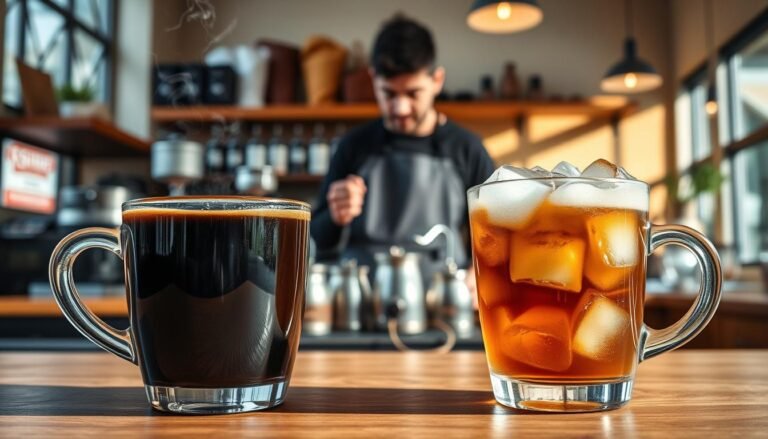
Hot coffee uses heat to pull dissolved solids and stimulant much faster. For a 16‑ounce serving, many hot methods fall between about 210 and 360 mg. That often edges past a typical 16‑ounce cold brew at roughly 205 mg (Starbucks reference).
Brewed hot then cooled
Iced coffee is brewed hot and then cooled. A 16‑ounce iced coffee often measures near 165 mg, which is usually lower than an equivalent 16‑ounce cold brew.
Espresso: concentrated by ounce
Espresso packs a lot per ounce. A single 1.5‑oz shot can be around 150 mg, yet total levels stay lower than a 16‑ounce cold brew unless we add extra shots.
- Cup size drives total intake: larger sizes or doubles can exceed a single 16‑oz drink.
- Chains vary recipes; ratio and roast shift caffeine per serving.
- Smoother taste does not always mean less stimulant.
| Type | Approx. mg per 16 oz | Key factor |
|---|---|---|
| Hot coffee | 210–360 mg | Heat and extraction |
| Iced coffee | ~165 mg | Pre-brew then cool |
| Cold brew | ~205 mg | Ratio and steep time |
What actually drives caffeine content in cold brew
A few simple variables explain why one chilled steep can feel mild while another packs a punch. We can control most of them easily at home to hit a predictable strength and flavor.
Ratio matters: grounds to water
Using more grounds per unit of water raises concentration. A higher ratio increases dissolved stimulant and total mg per serving.
Grind size and surface area
Finer grind exposes more surface area. That speeds extraction and lifts caffeine levels compared with coarser particles.
Steeping time
Most extraction happens in the first 7 hours, but extending to 12–24 hours nudges levels higher. Time and ratio together set the practical limit.
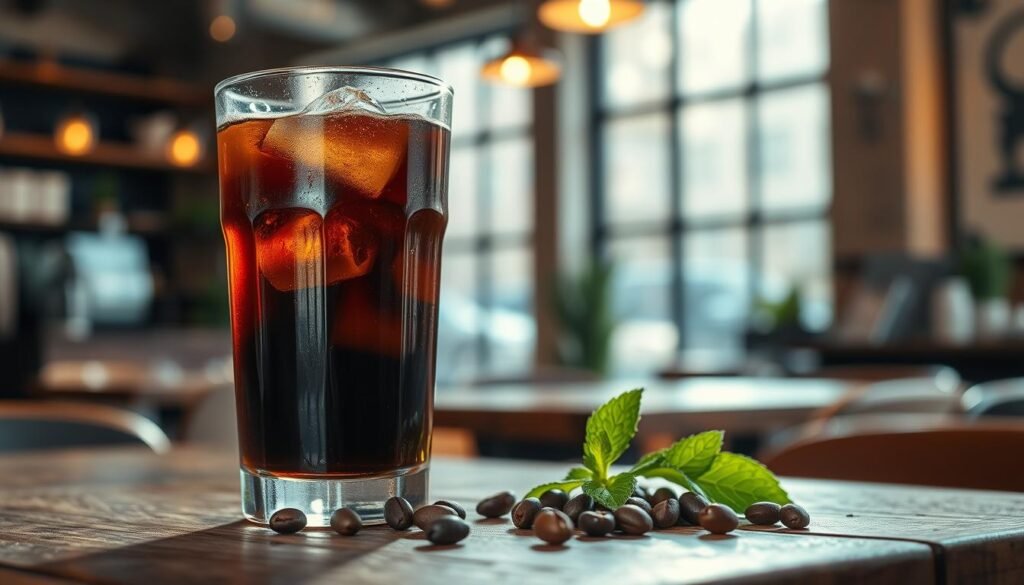
- Beans and roast: Robusta has more stimulant than Arabica; light roasts hold slightly more by weight.
- Water temperature and serving size: cold water extracts slower, so larger cups or stronger ratios raise total mg per cup.
- Repeatability: lock in ratio, grind size, hours, and bean choice and record weights to replicate desired levels.
| Factor | Effect on strength | Practical tip |
|---|---|---|
| Ratio | High ratio → higher mg per serving | Weigh grounds and water |
| Grind size | Finer → faster extraction | Use a burr grinder and note setting |
| Steep time | Longer → incremental increase after 7 hours | Test at 8, 12, 24 hours |
Next we will show the math for estimating caffeine cold brew at home using labels, dilution, and simple tools.
How we estimate and manage caffeine at home
A few simple measurements let us turn a bottle label into an exact per‑cup number.
Read the label
Many ready‑to‑drink bottles list caffeine per serving by law. That number gives us a baseline.
Check serving size—bottles often contain multiple servings. Divide total mg by the servings to get the true amount we pour.
Do the math: concentrate and dilution
If a cold brew concentrate lists mg per serving, apply your water ratio to estimate final mg per cup.
Example: a concentrate serving with 200 mg, diluted 2:1 water to concentrate, yields about 100 mg per final serving of equal volume.
Use TDS tools wisely
Refractometers and TDS meters help standardize strength. TDS does not equal stimulant directly, but steady TDS predicts steady extraction and more consistent caffeine levels.
- Standardize cup size and measure concentrate volume.
- Log grounds weight, water, ratio, and steep time for repeatability.
- Recheck readings when you change beans or grind.
| Item | What to record | Practical tip |
|---|---|---|
| Label | mg per serving, serving size | Calculate mg per your cup |
| Concentrate | Declared strength, dilution | Apply water ratio before serving |
| TDS reading | % dissolved solids | Use to match batch strength |
Brewing for less caffeine without losing the flavor
If we want less stimulant but the same smooth sip, small recipe shifts do most of the work.
Start by lowering the coffee-to-water ratio and shortening steeping time. Much of the stimulant dissolves by about seven hours, so cutting hours reduces total extraction with limited flavor loss.
Lower-strength ratios and shorter steeping time
Use a weaker ratio to cut overall strength. Test at 6–8 hours rather than 12–24 to keep body but reduce stimulant extraction.
Coarser grind size and 100% Arabica beans
A coarser grind limits over-extraction and bitter notes. Choosing 100% Arabica beans further lowers natural stimulant compared with Robusta blends.
Decaf options and less acidic profiles
Decaf beans give the greatest reduction while preserving smooth, less acidic character. Decaf cold brew still tastes richer and often less acidic than many hot methods.
- We standardize ratio, grind, and hours to hit a target stimulant level.
- Taste, then tweak: raise ratio or hours in small steps if the cup feels too light.
- Remember dilution and ice further lower stimulant per serving at pour time.
| Adjustment | Effect | Practical tip |
|---|---|---|
| Lower ratio | Less stimulant per ounce | Weigh grounds and water |
| Shorter steeping time | Reduced extraction after ~7 hours | Test at 6–8 hours |
| Coarser grind / Arabica | Less extraction, lower natural stimulant | Choose single-origin or sweet roasts |
Brewing for higher caffeine when you need the boost
When we want a real energy boost, small recipe moves and gear choices deliver measurable gains. We focus on three levers: ratio, time, and grind, then pick beans and serving style to match our tolerance.
Stronger ratios and longer steeping hours
We raise the coffee-to-water ratio and push steeping toward 18–24 hours to extract more stimulant. Longer hours increase amount, but we taste often to avoid muddled flavor.
Grind adjustments and concentrate serving sizes
Moving slightly finer within the cold range increases extraction efficiency. Serving as concentrate or minimizing dilution keeps mg per serving high, so we measure ounces poured for consistency.
Bean choices: considering Robusta and high-caffeine blends
Robusta and high-caffeine blends raise per‑serving strength versus Arabica. For flavor-first drinkers, an Arabica-forward blend paired with higher ratio and longer hours still yields a strong cup.
- Advanced gear with forced agitation can boost extraction (2021 study shows notable increases) and shorten batch time.
- Reduce ice and milk when peak potency is the goal; they dilute the serving.
- Log ratio, grind, hours, and serving size. Test small batches before scaling up.
| Adjustment | Effect on caffeine | Practical tip |
|---|---|---|
| Higher ratio | Significant increase per ounce | Weigh grounds and water |
| Longer steeping (18–24 hours) | Maximizes extraction | Taste at 12, 18, 24 hours |
| Finer grind | Faster extraction, higher amount | Keep in cold range to avoid over‑silt |
| Robusta / blends | Higher natural stimulant | Use for targeted boost |
From kitchen gear to commercial systems: controlling consistency
Gear choices shape how repeatable our batches are, from a home jar to a full-service system.
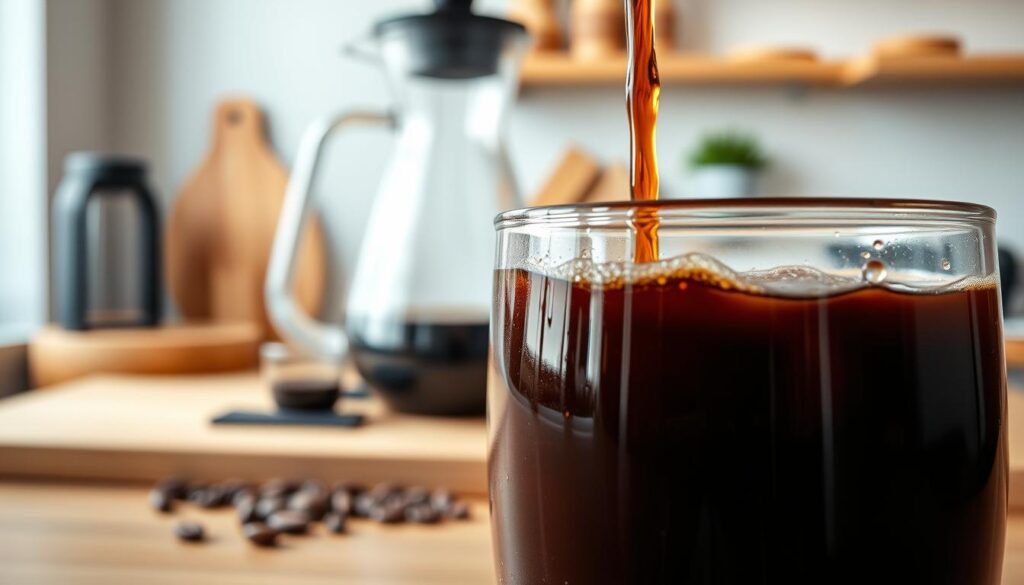
Traditional immersion relies on static steeping for 12–24 hours. It is simple and forgiving, but batch-to-batch levels vary with grind size, saturation, and time. Forced percolation or agitation systems circulate water through grounds to speed extraction and tighten consistency.
One study found a forced-agitation system (Hardtank) produced up to 18% more caffeine than hot methods and about 12% more than standard immersion. Programmable machines let us lock in time, ratio, and grind size so we reproduce strength reliably.
Replicating process with tools
We use TDS checks as a quick batch metric. TDS does not equal stimulant directly, but steady TDS predicts steady extraction.
At home, digital scales, timers, and a refractometer tighten outcomes without commercial hardware. In shops, saved recipes on machines keep multi-operator teams on the same page.
- Handle grounds evenly to avoid channeling and under-extraction.
- Log water amount, ratio, grind size, and contact time when you change inputs.
- Use filtration and consistent water to improve clarity and repeatability.
| System | Typical cycle | Effect on extraction | Practical tip |
|---|---|---|---|
| Immersion (home) | 12–24 hours static | Variable extraction; slower | Weigh grounds and time each batch |
| Forced agitation / percolation | Minutes to hours; circulated | Higher extraction, tighter variance | Use program presets and TDS checkpoints |
| Programmable commercial | Stored cycles, repeatable | Most consistent output for service | Save recipes and train operators |
Cold brew, less acidic taste, and your daily intake
A milder-tasting cup can still deliver a substantial stimulant dose, so portion control matters. The less acidic profile often helps digestion, but the stimulant totals remain the main driver of effects like jitters and sleep loss.
Managing jitters, sleep, and anxiety with serving control
We recommend setting a personal daily limit based on typical numbers: a 16 oz cold brew at a major chain is about 205 mg, iced coffee roughly 165 mg, and many hot coffee servings range 210–360 mg per 16 oz.
Track how many cups and the serving size you consume. Reduce size or dilute when you notice restlessness, and space pours to avoid stacking peaks.
Practical limits: how much caffeine per day fits your routine
- Use 200 mg as a practical reference for a large cup and sum totals across the day.
- Front-load intake before mid-afternoon to protect sleep.
- Swap to a low-caffeine or decaf batch for late-day enjoyment and stay hydrated with water between servings.
| Drink | Typical mg / 16 oz | Practical tip |
|---|---|---|
| cold brew | ~205 mg | Measure ounces and dilution |
| iced coffee | ~165 mg | Check label for serving size |
| hot coffee | 210–360 mg | Limit late-day cups |
Your path to dialing in cold brew caffeine, cup after cup
Consistent results come when we lock a few variables and record each batch.
Fix ratio, grind, hours, bean type, and a dilution plan so the caffeine content and flavor stay stable. Use a simple worksheet to note coffee beans weight, water volume, grind setting, steeping hours, and concentrate dilution.
Set a target caffeine per cup (≈200 mg per 16 oz as a baseline), test two to three small variations, then lock the recipe for weekday brewing. Programmable systems and occasional TDS checks help us confirm repeatability as we switch beans or scale batches.
Measure servings, read labels, and review the routine monthly. Target, log, measure, repeat—this checklist keeps our cup predictable and enjoyable.